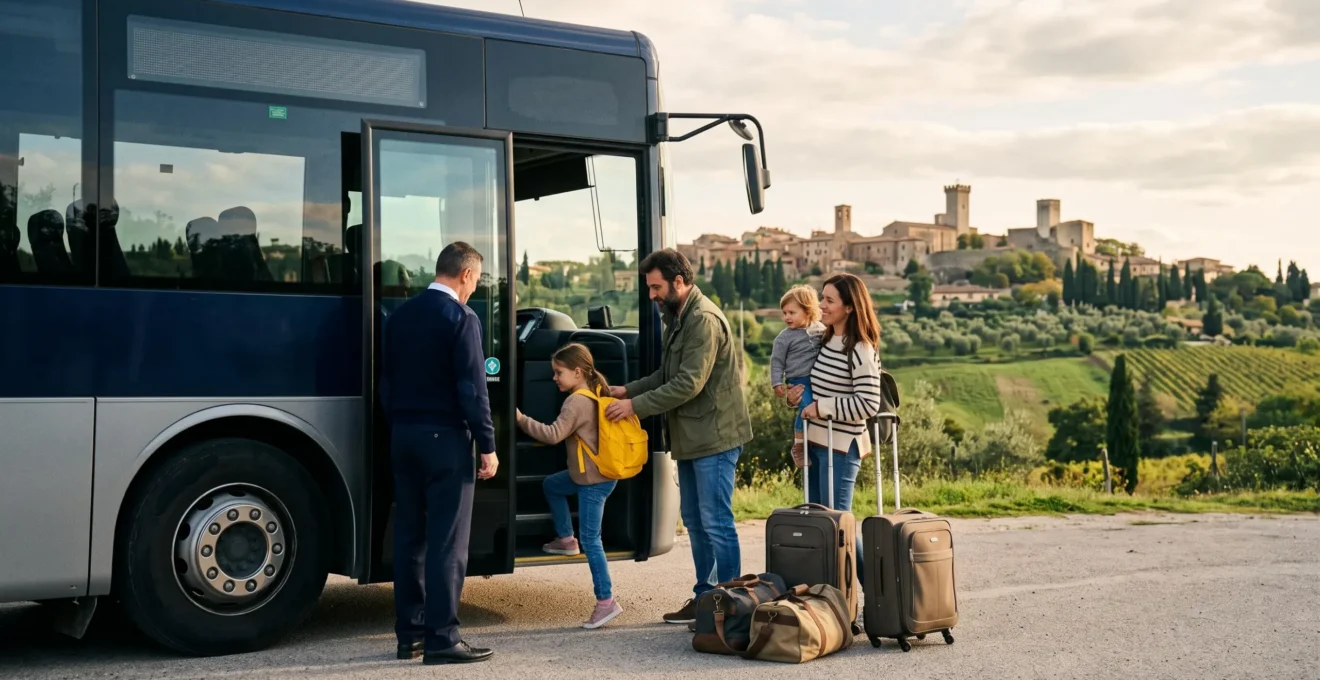
Yes. Families can use a dedicated tourist pass for multi-city travel in Tuscany, but its coverage is more limited than the name may suggest. The current Tuscany Travel Pass connects five destinations—Florence, Pisa, Lucca, Siena and San Gimignano—rather than providing blanket access to every public bus or town in the region.
That distinction matters when planning a car-free trip. A family staying within those five destinations can compare the tourist pass with individual transport options, while an itinerary extending elsewhere will normally require ordinary public transport for the uncovered legs. Children’s ages can also change the calculation because scheduled regional buses follow different child rules from the tourist product.
Yes — but the Tuscany Travel Pass covers five key destinations
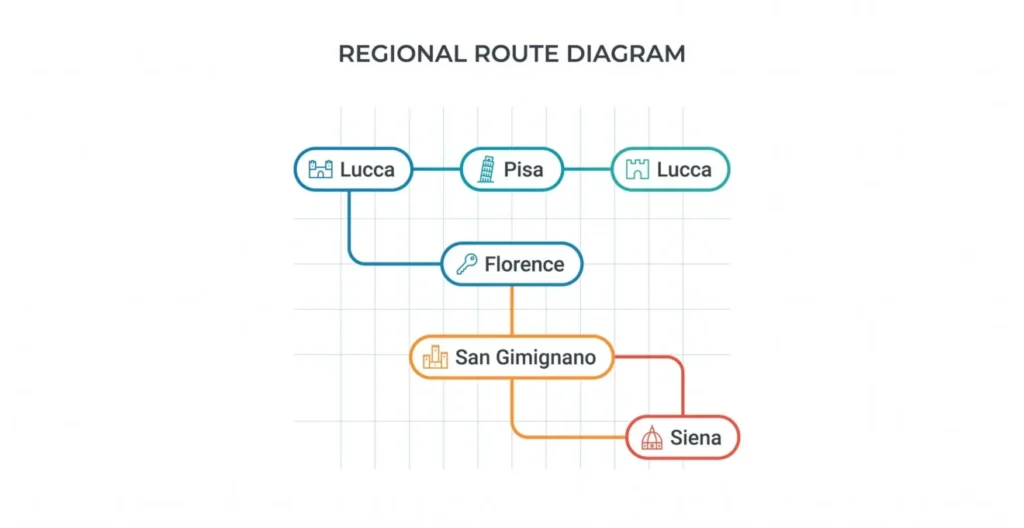
According to the current Tootbus Tuscany product page, the pass allows unlimited journeys during its selected validity period on two tourist routes serving Florence, Pisa, Lucca, Siena and San Gimignano. At the time of verification on September 28, 2026, it was offered for 1, 2, 3 or 5 days.
Direct answer: A family-oriented multi-city bus pass does exist for Tuscany, including a Family 2+2 booking category. However, it applies to the five destinations served by the two Tootbus Tuscany routes, not to every public bus or destination across the region.
The route structure is straightforward. One route links Florence, Pisa and Lucca, while the other links Florence, San Gimignano and Siena. This makes the product most relevant to families building a trip around those particular cities rather than treating Tuscany as one unrestricted transport zone.
What the coverage really means: The pass is designed around five named destinations and two tourist routes. It should not be interpreted as a region-wide pass for all scheduled public transport in Tuscany.
The distinction is supported directly by the Tuscany Travel Pass product information. For planning purposes, the safest approach is to compare the family’s intended stops with those five cities before considering price or convenience.
Why the pass can work well for a family itinerary
The family-oriented element is explicit in the current booking interface. Tootbus lists Adult 13+, Child 4-12 and Family 2+2 participant categories. That does not mean every possible family configuration receives a special fare, but it does confirm that a dedicated two-adult, two-child option is built into the product.
For a family moving repeatedly between destinations within the covered network, one pass can also reduce the need to manage separate tourist-route tickets for each journey. The benefit is primarily organizational: fewer individual purchases and a clearer multi-day transport plan within the product’s own network.
Check the live fare before booking: On September 28, 2026, the booking page displayed the Family 2+2 option at €95.90 against a displayed reference price of €137.00. That was a promotional price snapshot, not a permanent tariff, so the current amount should be verified again before payment.
This distinction between a durable product feature and a temporary price is important. The existence of the Family 2+2 category can inform trip planning, while the actual fare remains volatile and should not be used as a fixed benchmark for future travel dates.

Ordinary Tuscan buses follow different ticket and child rules
Families travelling beyond the five tourist-pass destinations will need to look at ordinary scheduled public transport for those additional legs. Autolinee Toscane operates urban and extra-urban bus services under a different ticket structure, so its rules should not be mixed with Tootbus fares or age categories.
Ordinary suburban passes are generally tied to the origin-destination journey shown on the pass and the return journey. They are therefore different from a sightseeing product designed for repeated travel among a small set of tourist destinations. For families considering lower-impact transport more broadly, this also connects naturally with other gentle mobility options that can complement a car-free trip.
Child travel rules are especially important. Autolinee Toscane’s child travel rules state that a child currently travels free up to the 11th birthday when accompanied by an adult passenger, subject to the operator’s stated exception for services integrated with school transportation.
Do not mix the two child-fare systems: Tootbus currently uses commercial Adult 13+, Child 4-12 and Family 2+2 booking categories, while ordinary Autolinee Toscane services apply their own under-11 accompaniment rule. These conditions belong to different transport products.
An older tourist guidance page still accessible at the time of verification referred to a height-based criterion. That wording should not be used as the current general rule because the dedicated child transport guidance now provides the age-based condition above.
Pegaso is useful for some mixed bus-and-train journeys
Pegaso is a different type of transport product. Official Tuscany integrated-fare documentation describes it as covering participating regional rail services, urban buses, extra-urban buses and Florence tram services. The documented formats include a daily ticket as well as monthly and annual subscriptions.
That makes Pegaso relevant when the family’s itinerary depends on combining rail with local public transport rather than staying only on the two tourist bus routes. It should not be described as a dedicated Family 2+2 sightseeing pass, because its purpose and fare structure are different.
For travellers who want rail to play a larger role in the itinerary, this distinction can lead naturally into planning around panoramic train travel alongside bus connections.
| Option | Coverage and transport | Family relevance |
|---|---|---|
| Tuscany Travel Pass | Two tourist routes linking Florence, Pisa, Lucca, Siena and San Gimignano. | Includes a current Family 2+2 booking category. |
| Ordinary Autolinee Toscane travel | Urban and extra-urban public transport; suburban passes are linked to a selected origin-destination journey. | Current rules allow accompanied children to travel free up to their 11th birthday, subject to stated exceptions. |
| Pegaso | Integrated participating regional rail, bus and Florence tram services. | Useful where a trip depends on combining transport modes rather than using a dedicated sightseeing pass. |
Choose the pass from your itinerary, not from the label
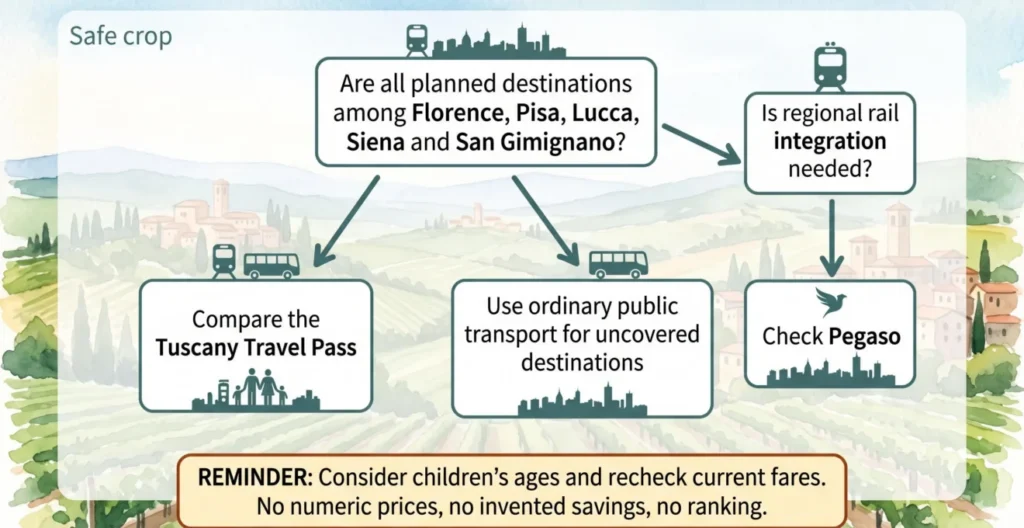
The most useful way to choose is to start with geography, not with the word “pass.” First list every destination the family actually plans to visit, then separate journeys that fall inside the five-city tourist network from journeys that require other public transport.
Which transport approach should a family check first?
- All planned destinations are Florence, Pisa, Lucca, Siena or San Gimignano:
Compare the Tuscany Travel Pass with the ordinary ticket options needed for the same itinerary. Do not assume one is cheaper without checking current fares for the actual travel dates.
- The trip includes destinations outside those five cities:
Plan ordinary public transport for the uncovered legs, because the tourist pass should not be treated as a region-wide network ticket.
- Regional trains are an important part of the journey:
Check whether Pegaso’s integrated transport conditions fit the planned route and services.
- Children are travelling:
Factor their ages into the comparison, especially because ordinary Autolinee Toscane buses currently apply a separate under-11 accompaniment rule.
This decision method does not claim that one option is universally cheaper or better. Its purpose is to compare the products on the criteria that actually change the trip: destination coverage, transport mode, number of cities, children’s ages and the need for rail integration.
A five-city itinerary can make the tourist pass worth evaluating because its coverage matches those destinations directly. Once the route expands beyond that network, a mixed ticket strategy becomes more likely. Families planning broader multi-city breaks can apply the same principle: define the stops first, then match transport products to the actual route instead of assuming one pass covers everything.
A practical final step is therefore simple: write down the family’s destinations and children’s ages, identify which journeys fall inside the five-city tourist network, and then check the live fares and conditions for the remaining services. A family-oriented pass does exist for the main Tootbus Tuscany circuit, but travelling more widely across the region may require ordinary or integrated public transport alongside it.